
Notes From the Pathway of Wonder and Awe - The Mystery of Belonging
Prefer to listen to this as a podcast? You’ll find it on Spotify and Apple Podcast

Milne Bay Province, Papua New Guinea, 2007
We arrive at the airport, with plenty of time to spare, to find the new extension is open. When we’d first arrived the place was a tin roof above a conveyor belt at the end of a small tarmac. A simple wooden plaque with the name Gurney Airport, Milne Bay Province painted on it greeted us as we alighted from the aircraft. The new building was modest and not yet finished.
The place is eerily deserted. A couple of brand new check-in desks stand unattended.
Rows of empty seats look straight out onto the runway. But there is no plane. There is nothing to do except sit down and wait.
Before long a woman appears and sits in front of us.
I lean forward, ‘do you know when check in opens?’
She shrugs her shoulders, ‘who would know.’
‘But the plane is due to depart soon and I can’t see one on the tarmac. And there are no other passengers.’
She looks at me knowingly.
‘People will arrive when the plane comes. And the plane is often late.’
‘Often late,’ I repeat.
‘Yes, sometimes a few hours, or a day, or even a week.’
‘A week!’ I feel panic rising. Our plane back to Australia leaves Port Moresby late today!
I notice that she is covered in fierce red bites. ‘What happened, do you want some cream?’
She shrugs again. ‘I’ve been in the Highlands for months and just learnt to put up with it.’
‘What have you been doing?’ I asked, all ears. She had an Australian accent and wasn’t all that old.
‘Oh, I’m an anthropologist, I work for the British Museum and for my first project they gave me a suitcase of old photos taken of indigenous Papua New Guineans during the missionary era. They had never been catalogued and my brief was to find out who they belonged to and return them.’
I looked at her incredulously, ‘how on earth did you do that?’
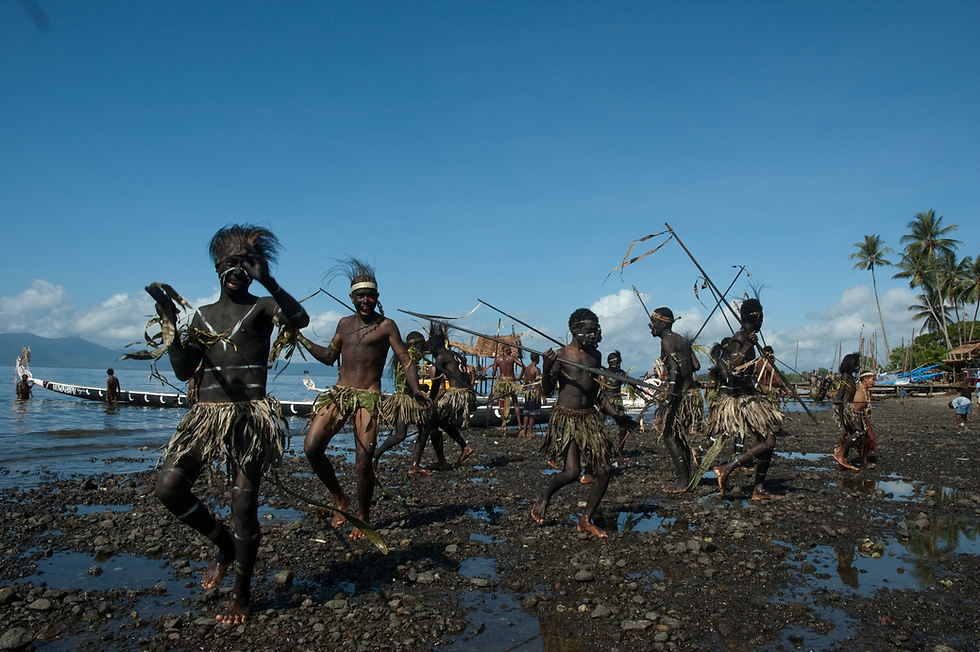
‘Well I was floored when they first assigned the job to me. When I arrived here I was met by six Highland men who were to be my escort and we walked into the Highlands. It’s very tricky you know, it is still wild out there and I was warned to stay close as we could be ambushed along the way at any moment. It’s very dangerous to be white, let alone a white woman, in some of those areas.
She told me she initially hadn’t a clue how she would get this assignment done but she decided to go to each school in the region where the locals were invited to come and meet her and see the photos. And lo and behold, people recognised their kin in the photos.
She went from area to area, to each school or meeting place, and showed the photos until all had been claimed.
‘What did you do with them?’
‘I left them in the care of the relevant school libraries.’
Suddenly the tiny airport filled with people and a plane landed out the front.
A tiny twin propeller plane.
The door opened and a short, narrow flight of steps unfolded to the ground.
I looked at all these people who had suddenly arrived. How are they all going to fit on that tiny plane? But, of course, they were families bringing a family member who was going on the plane. And, yes, this was the right plane… because, said the anthropologist… ‘you never know what plane will turn up.’
I thought about that. The families bringing a loved one to see them safely on their journey. The web of interconnection in traditional communities. A deep sense of belonging to a people, a family, a place.
That story of recognition has stayed with me. People recognised kin in old photos from decades ago. People who had been long gone from this life - some many generations removed. I have heard similar stories before in indigenous communities.
When I think about the feeling I get when I drive the coastal road home, it is also a recognition. Every time I drive along that road it lifts my heart and soul. It’s an epic kind of experience that brings tears to my eyes. It’s a feeling that never goes away. I know I am on my way home. The familiarity of the road, the rolling breakers, the salty smell, the little hamlets and occasional villages nestled into the unfolding, rugged coastline. The light on the water. It is a visceral experience of being part of the place. A standout, constant thread of belonging that runs through my life. And it’s through allowing ourselves to have these experiences that we continue to deepen into being part of this mystery. I could always choose to drive the faster way home, along the inland road before cutting through the mountains to the coast, but sometimes I get that feeling to drive the coastal way, and I never regret it.

I have a little joey in care at the moment, he is tucked in pouches that provide warmth and safety. I take him for walks in the fresh air so he can feel movement and take in the smells and sounds - all things that would naturally be part of his day in the wild. I see him lift his head back in swamp wallaby style breathing everything in and looking out before snuggling back down and fixing his eyes on my face above - just as he would if he were in his mother’s pouch.
A sense of belonging enlarges our experience of life. It creates a feeling of safety and connection. Working with wildlife has taught me that safety is a number one priority when we rescue any animal.
When I think about my connections over the years with different people and places, and the way I have been welcomed in, I recognise my own response to feeling safe. The deep sense of belonging this recognition evoked in me, no matter where I was. The feeling of safety soothed the deep anxiety I often felt at being away from my loved ones. Away from my place in the world that I call home.
Belonging is grounded in our experience of interconnectedness with each other, the natural world, and a larger, universal whole. The deeper current is the mystery that we are all part of.
I can trace such moments of belonging like bright threads woven through my life journey. They have appeared in unexpected places and in many different forms. In south west Papua New Guinea. In the ancient landscapes of the Northern Territory. Watching whales migrate along the southern Coral Sea off Stradbroke Island. In a tipi meeting in the desert of New Mexico. In underwater caverns on Grand Bahama. Such moments are standout moments. Bright moments that are embellishments like knotwork in embroidery, adding detail and beauty to our stories.
Take time to look back across your own life.
What are the moments that are still alive within you? Which places have become part of who you are? Which encounters awakened a deeper sense of connection with life itself?
You may discover that they form a thread. A thread woven through your life by moments of recognition, relationship and participation. A thread that has been steadily leading you towards the recognition that you have always belonged.
Every place that has touched us, every encounter that has awakened wonder, every moment when we have recognised ourselves as part of something larger, becomes part of us. We carry them with us, and with them, a deeper sense of belonging.
This is part of the mystery of belonging. We belong because we are part of life.

Wild Wisdom Membership is entering a new season.
Our next member calls take place next weekend, as we continue our exploration of The Heart of Belonging.
Behind the scenes, we are reshaping the way people enter and continue within Wild Wisdom—including a more personal way to begin and a simpler, more accessible ongoing path.
I’ll be sharing more very soon.
If you have been feeling drawn to come closer to this work, stay close.
Much love


